How to tell the difference between
CSA 6 (London print) or CSA 7-L (Local print on De La Rue London paper) and
CSA 7-R (Local print on Richmond paper), the New York Counterfeit, and other pretenders
Catalog Numbers are from the Confederate States of America Catalog and Handbook of Stamps and Postal History
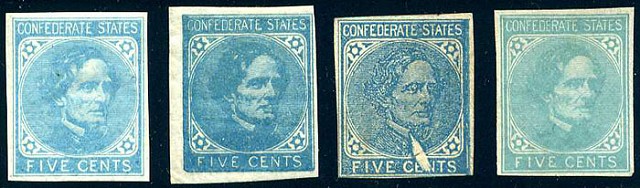
Left to right: CSA 6, London Print; CSA 7-L, Local (or Richmond) Print on London paper,
CSA 7-R, Richmond Print with white tie variety, and New York counterfeit.
The London and Richmond prints are commonly confused, but with a bit of experience they are generally not that hard to tell apart due to differences in paper, gum, and printing characteristics. The New York Counterfeit is seen almost as often as the "real thing," and copies are offered and sold on eBay as genuine CSA 6 almost every day to the non-specialist. They are also found at virtually every stamp bourse and are offered unknowingly by dealers who do not specialize in Confederates. Your best defense is knowing the differences yourself.
CSA 6, London Print: produced by Thomas De La Rue & Co. in London, England, on thin hard-surfaced paper. The image was engraved in relief on steel, electrotyped, and flat-bed printed. Impressions are sharp and clear, and the ink is a consistent shade of blue. The gum is thin, even, transparent, and almost colorless.
De La Rue shipped both the printing plates and a quantity of stamp paper. Consequently, there are Richmond prints that are very close in quality to the London prints. However, there are many that are quite clearly "local prints," such as the second-to-the-left example above, which has obviously filled-in frame lines most noticeable at left and at bottom, as well as filling in the fine lines of the hair and a rather "muddy" appearance to the entire stamp. Not all Richmond prints will have the filled-in frame lines, but if it does, then you can be assured it is not a London Print.
CSA 7-L and CSA 7-R, Richmond Prints: printed by the Richmond firm of Archer & Daly from electrotype plates provided by De La Rue on white wove paper in two grades - the thin glazed paper from London shipped with the plates (CSA 7-L) and an inferior coarse grade of paper with colorless thin gum of an inferior darker hue (CSA 7-R). The color of the successive printings ranges from pale blue to dark blue to the darker cobalt blue. The impressions are coarse with many plate (constant) and printing (variable) varieties. One of the most collectible plate flaws is the "white necktie" shown above. The second-from-the-left stamp shows filled-in left and bottom frame lines, a very collectible printing variety cataloged in the 2012 CSA Catalog. If the stamp you are examining has any printing defects, darker gum, or shows uneven application, large skips, or heavy brush marks, it is a Richmond print.
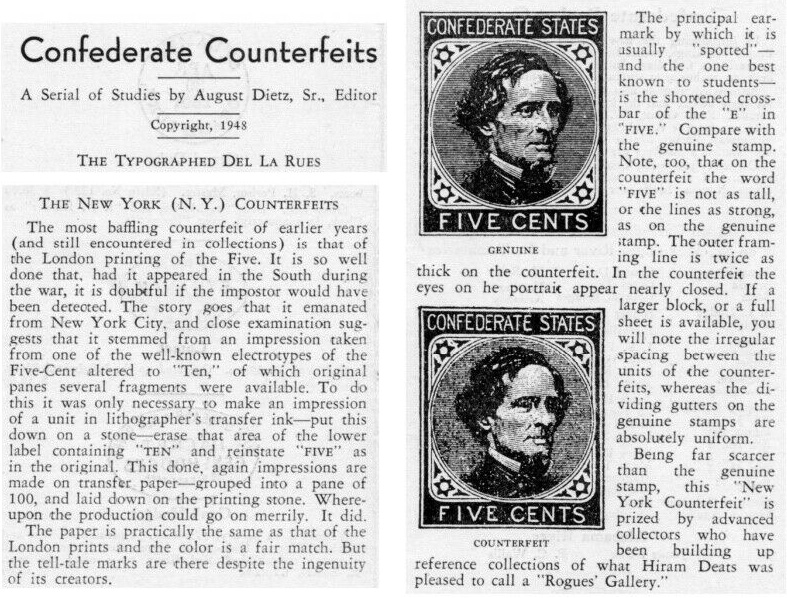
New York Counterfeit: This commonly encountered forgery was printed from an electrotype plate by J. Walter Scott for use in the Scott albums in the early 1900s or possibly even the late 1800s. The master die was photographically reproduced from a print of the ten-cent altered plate (the subject of another treatise), and the value on the tablet changed from "TEN" back to "FIVE." The first thing that jumps out at me, personally, is always the odd, cloudy, greenish-blue aqua color, which is nothing like the genuine stamp. There is no genuine shade like this. The next most obvious difference between the counterfeit and the original is the shorter crossbars on the "F" and the "E" of "FIVE" in the value at the bottom. When you compare them with the genuine Richmond print on the left, you will notice they are always significantly shorter than the originals. Other things to notice are the lack of detail in the eye (very little white area) and a general lack of clarity and definition. The outer frame line is also thicker than on the originals. There are some other minor differences, but those presented here are more than enough for you to correctly determine genuine from counterfeit. 1948 August Dietz description of New York Counterfeit
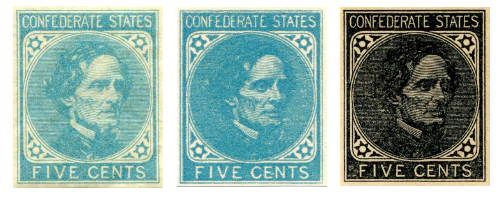
Compare the genuine CSA 6 London Print at left with Ward Private Printings in blue and black at middle and right (CSA Catalog # 6-U1-a and 6-U1b)
Philadelphia or Ward Unofficial Printings: Printed in blue and black from a complete plate of 400 that was on board the captured blockade runner Bermuda. Prints were made by the Franklin Institute in Philadelphia in 1954 by Philip Ward. The sheets are ungummed. The stamp has a flat, dull, lifeless appearance. Sometimes they are backstamped as well. The outer frame line is slightly thicker than on the genuine, and the letters are not as thick. On some examples, Davis’ hair blends into the background. The original printing plate was sold by the Franklin Institute to the Smithsonian National Postal Museum in April 2011 and is on display in the William H. Gross Stamp Gallery. The non-specialist is likely to have difficulty with these, particularly in the blue shade.
Springfield and Swiss Facsimiles: This commonly encountered counterfeit is often on newsprint-quality paper, and some are handstamped "facsimile" on the back. The facsimile is 1 mm narrower than the genuine stamp. They were "issued" by Tatham Stamp Co. of Springfield, Massachusetts, in 1934 to the collective horror of the philatelic community. They were copied without permission from copyrighted pen-and-ink drawings made in 1919 by August Dietz, Sr. Seasoned students recognize them at a glance. Sometimes they have the old Scott numbers printed on the back, e.g., 205, 206, etc. They are seen on eBay literally every day, sometimes described as such and sometimes not. There are also other Swiss-origin facsimiles that are very similar but have the modern numbering system on the backs, e.g., 1, 2, 3, etc.
Taylor / Woodcut Forgeries: These are very crude designs that bear absolutely no resemblance to the genuine and should fool absolutely no one when compared to genuine stamps or quality modern catalog illustrations. Examples can be seen in the Gallery of Curious Things on this website.